
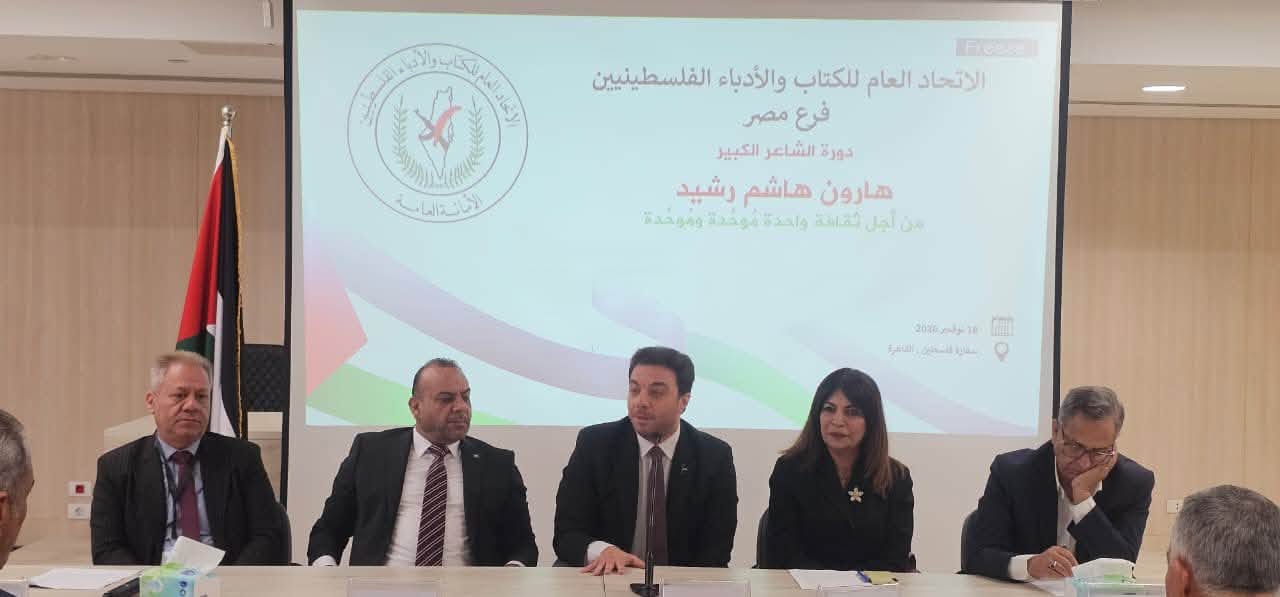
The General Union of Palestinian Writers and Authors successfully held a conference today, Wednesday, to establish the Union’s branch in the Arab Republic of Egypt. The conference comprised two sessions held at the headquarters of the Embassy of the State of Palestine under the title “Haroun Hashem Rashid Session” and the slogan: “One Culture, United and Unifying.”
The conference was attended by Ambassador Naji Al-Naji, Chargé d’Affaires of the Embassy of the State of Palestine in Egypt; the Union’s Secretary-General, poet Murad Al-Sudani; Secretary-General of the Popular Organizations in Egypt, poet Dr. Mohamed Ghareeb; Secretary of the Culture Committee at the Egyptian House of Representatives, writer Doha Assi; members of the Union’s General Secretariat, Dr. Shafik Al-Talouli, poet Abdul Salam Al-Attari, Dr. Seham Abu Al-Amrein, and poet Nasser Atallah; Chairman of the Administrative Council, poet Mohamed Ayyad; media professional Nasser Al-Shiouki, representing the Journalists’ Syndicate; as well as prominent cultural and literary figures and members of the Union’s General Assembly in Egypt.
Both sessions were moderated by poet Ibtisam Abu Saada, who welcomed the attendees, guests, and writers participating as members of the General Assembly.
Ambassador Naji Al-Naji emphasized the importance of cultural engagement and strengthening the cultural and literary landscape. He also highlighted the strong Egyptian-Palestinian relations, rooted in a distinctive shared history and a common destiny. The Ambassador further addressed the prisoners’ movement, particularly imprisoned writers, and underscored the importance of their role.
For his part, poet Murad Al-Sudani delivered an extensive address outlining the establishment of the Union’s branches in Syria and Lebanon, highlighting the significance of the Egyptian cultural scene and the need to unify cultural efforts as part of the preparations for a comprehensive General Conference bringing all these efforts together. He also stressed the importance of prisoners and their literary contributions in fostering a vibrant national cultural movement. He paid tribute to the founding martyrs and the early and subsequent generations who confronted opposing narratives through the power of the written word.
Al-Sudani affirmed that what politics divides, culture and intellectuals unite, describing them as an advanced vanguard of awareness and resistance culture.
In her address, writer Doha Assi, Secretary of the Culture Committee at the Egyptian House of Representatives, reaffirmed the well-established ties between Egypt and Palestine. She highlighted the significance of the conference given the critical circumstances facing the Palestinian cause and stressed the need to activate the Palestinian cultural scene, building on the deeply rooted Palestinian cultural heritage and its Arab and human dimensions.
Mohamed Gharib emphasized the importance of cultural initiatives that support the national cause, drawing on the depth of experience in confronting the occupation’s narrative and falsehoods. He stressed that culture must fulfil its role in safeguarding national identity and strengthening determination despite the painful realities on the ground.
Dr. Shafik Al-Talouli, Chairman of the Preparatory Committee, reviewed the committee’s work, its various stages and responsibilities, the circumstances surrounding the conference, and its communication with members of the General Assembly. He also outlined the preparation of the conference agenda, which was successfully completed through intensive efforts within a remarkably short period.
The conference also honoured a distinguished group of prominent writers and intellectuals who have made significant contributions to the Egyptian and Palestinian cultural scenes. The honourees included poet Hassan Talab; writer Ghazi Al-Sourani; writer Abla Al-Dajani; poet Ahmed Abdel-Moaty Hegazy; writer Mohamed Salmawy; researcher Mohamed Al-Az’ar; the late Ambassador Diab Al-Louh; the late Dr. Awda Boutros Awda; poet Abdel-Badie Iraq; writer Hind Al-Budairi; novelist Naji Al-Naji; writer Saleh Zakout; and poet Haroun Hashem Rashid.
At the opening of the second session, novelist Ziad Abdel Fattah nominated Dr. Shafik Al-Talouli to chair the conference. Dr. Al-Talouli then presented the session’s agenda, after which the Union’s Secretary-General, poet Murad Al-Sudani, delivered an address discussing the key issues on the agenda and assessing the collective spirit that would constitute an important outcome of the session.
The floor was then opened for discussion among members of the General Assembly, whose contributions enriched the session and presented various perspectives aimed at ensuring its success and establishing the membership of the Union’s Egypt branch.
Following consultations, Secretary-General Al-Sudani presented a proposed list of members to serve on the branch’s secretariat. The proposal was approved, and the secretariat was formed as follows:
Maher Al-Maqousi
Ibtisam Abu Saada
Hisham Abdel Aal
Zeinat Abu Shawish
Kamil Abu Hanich
Jaafar Abu Hananeh
Saed Abu Jajouh
Hind Joudeh
Iman Al-Louh
The conference concluded with the issuance of its final statement.

