
Report by: Khaled Reda – Zainab Suliman
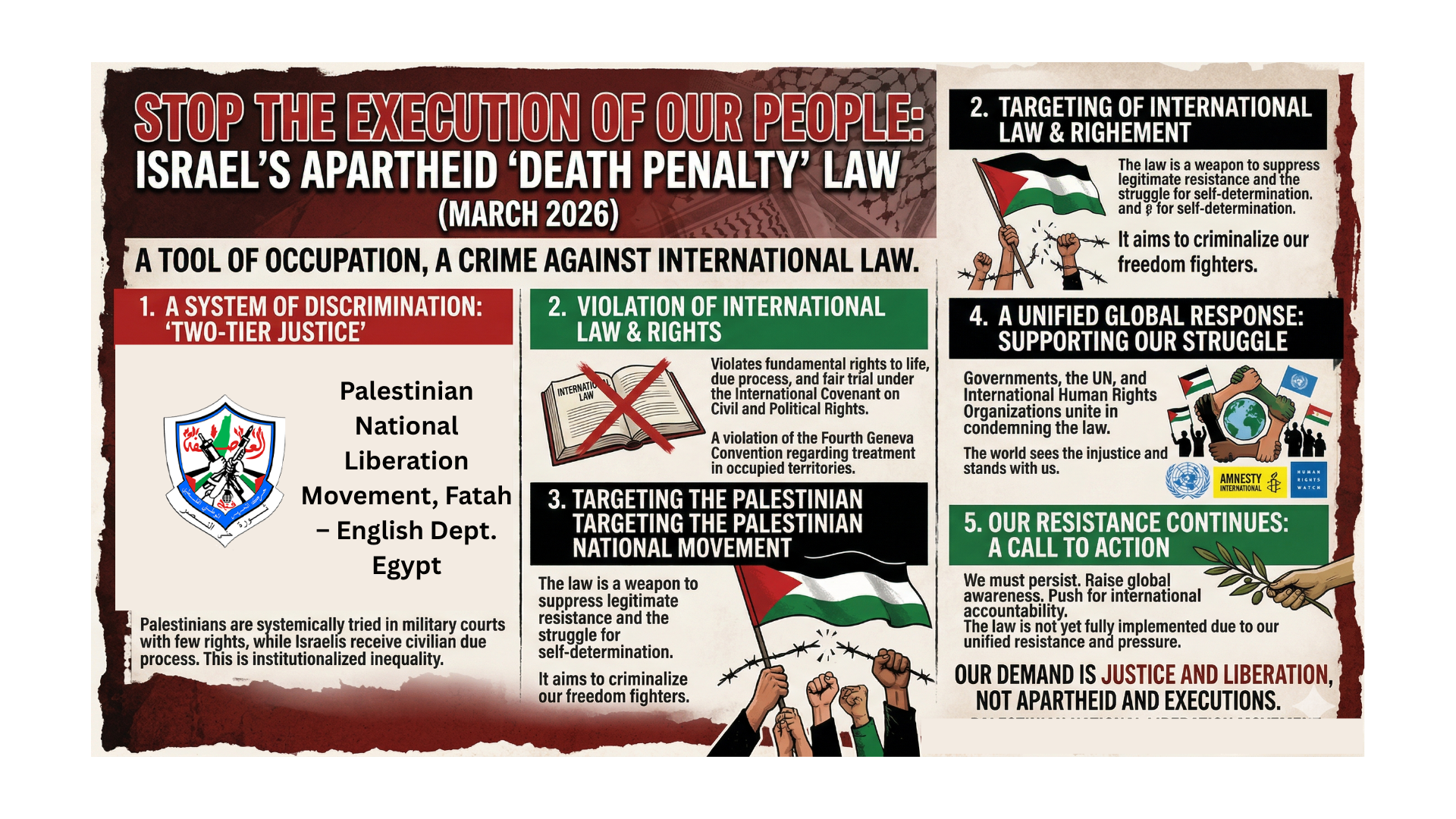
In March 2026, the Israeli Knesset passed a law permitting the death penalty for Palestinians tried in military courts. The law is widely viewed as a dangerous escalation targeting Palestinian prisoners, many of whom are already held within a legal system criticized for lacking basic guarantees of fairness. It raises immediate concerns about the potential for irreversible punishment in cases where due process is disputed.
The law allows for executions in cases handled by military courts, which primarily prosecute Palestinians in the occupied territories. These courts have long been criticized for high conviction rates and limited procedural protections for defendants. In this context, the introduction of capital punishment is seen as deepening an already severe imbalance in the judicial system, where safeguards considered standard in civilian courts are often not fully applied.
For Palestinian prisoners and their families, the impact is severe and direct. The legislation places thousands of detainees under the threat of execution, intensifying fear and uncertainty across communities with widespread ties to incarceration. Families of prisoners now face the possibility that imprisonment could lead to execution, compounding psychological distress and long-standing concerns about detention conditions and legal representation.
Palestinian civil society organizations and advocacy groups argue that the law fits into a broader pattern of increasingly harsh measures affecting detainees. They warn it could accelerate punitive outcomes and further restrict access to fair legal processes. In this context, the law is viewed as an extension of existing concerns regarding administrative detention, prison conditions, and structural inequalities within the military justice system.
Palestinian political institutions have strongly condemned the legislation, describing it as a violation of international humanitarian law and a serious threat to prisoners’ rights. Community responses have included public protests, awareness campaigns, and increased advocacy efforts focused on the protection of detainees and opposition to the implementation of the law.
Legal and human rights experts argue that applying the death penalty within military courts raises serious concerns regarding compliance with international legal standards, particularly in relation to fair trial guarantees and the right to life. Critics highlight that the combination of capital punishment and contested judicial safeguards creates a heightened risk of miscarriages of justice.
The law has also drawn strong international reactions, with multiple governments and international organizations condemning it as inconsistent with human rights obligations. These statements are often cited by opponents of the law as evidence of its controversial nature, although there remains concern about the lack of concrete measures to protect prisoners affected by it.
Overall, the legislation is seen as significantly increasing the stakes for Palestinian detainees, transforming imprisonment into a potentially irreversible outcome in certain cases. It intensifies existing tensions surrounding military courts and detention practices, and deepens fears among prisoners and their families about the future of those in custody.

